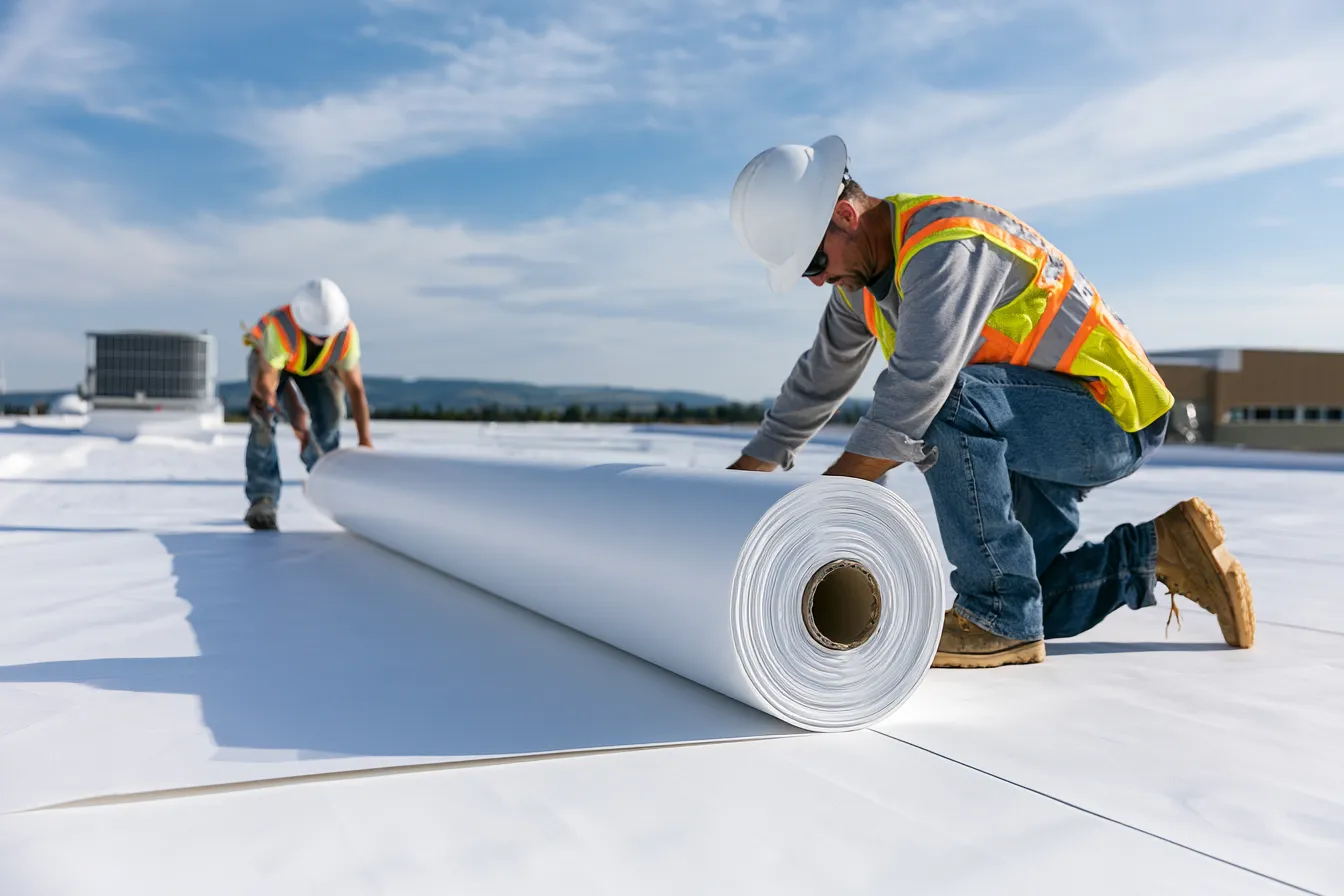
Commercial TPO Roofing in Springdale, AR
TPO roofing in Springdale, AR is a white, heat-welded single-ply membrane that reflects the Arkansas sun and seals a low-slope deck flat. Its welded seams and mil thickness decide it.
- A read of the membrane and every welded seam
- Mil thickness matched to the county's hail
- Reflective white sized to an Arkansas summer
Why TPO fits a Springdale building
A TPO roof is a single-ply thermoplastic membrane, and its seams are heat-welded rather than glued into a single watertight skin. It covers most of the low-slope roofs going up on Springdale's newer offices, strip retail, and plants, because it does two things a working building wants: it welds shut and its white face throws the Arkansas sun back off the deck.
A roofer sizes the membrane to the summer heat and to a county that sees real hail, names the mil thickness the storm record calls for, and welds each seam to spec, since a low-slope roof lives or dies at the weld line.

What a TPO read writes down
Whether a roofer is reading an aging TPO roof or scoping a new one, it reduces to a short checklist an owner can follow before a number lands.
- 01The mil thickness, sized for the hail
- TPO sheets run in a few thicknesses, commonly forty-five, sixty, and eighty mil, and a heavier one shrugs off hail bruising, foot traffic, and UV for longer. In a county that logs real hail a roofer sizes the mil to the storm record and to how much traffic the rooftop units draw, rather than reaching for the thinnest sheet a low bid tends to carry.
- 02Every seam hot-air welded into one skin
- A single-ply roof holds or fails at its seams, so each is hot-air welded, not taped or glued, into one continuous surface. A roofer probes the finished welds, because a weld that looks closed but never fully fused is the leak the next Arkansas rain finds first.
- 03A white surface for the Arkansas summer
- A reflective TPO surface pushes sunlight back and can cut the rooftop temperature and the cooling load, which counts on a conditioned plant or a cold-storage building running compressors all summer. A roofer checks the energy code on the books to see whether a reflective roof is expected here, rather than assuming it either way.
- 04PVC where grease-laden exhaust lands
- TPO is the wrong membrane under a kitchen or plant exhaust fan, where grease-laden air falls on the roof, because animal fats degrade it. On a food building a roofer specs a PVC membrane in those zones, since PVC resists the grease and chemicals a working plant throws at the roof.
- 05Hidden hail found and dated up close
- Hail bruises a flat membrane where the ground cannot see it, so after a Washington County storm a roofer walks the field, presses for soft spots, and photographs any bruising or split weld. That record is the roof's, and it is what an adjuster needs when a claim follows.
A flat roof hides hail damage a pitched roof would show, so a bruised membrane or a split weld reads as nothing from the lot. For what a storm leaves on a low-slope roof, the storm damage page lays it out, and the flat roof and EPDM guide covers the drainage side.
TPO questions from Springdale building owners
What a Springdale owner weighs before welding a TPO membrane onto a low-slope roof.
Q1Why do so many Springdale buildings wear TPO?
Q2What mil thickness should my TPO roof be?
Q3Does a white TPO roof actually cut cooling costs here?
Q4Is TPO the right membrane for a food plant roof?
Q5How does TPO hold up to Washington County hail?
Put your Springdale TPO roof on file
Hand Springdale Apex Roofing the building and a commercial roofer reads the membrane, names the mil and the welded seams, and writes one scope and number you hold until you say go. The read is free either way.