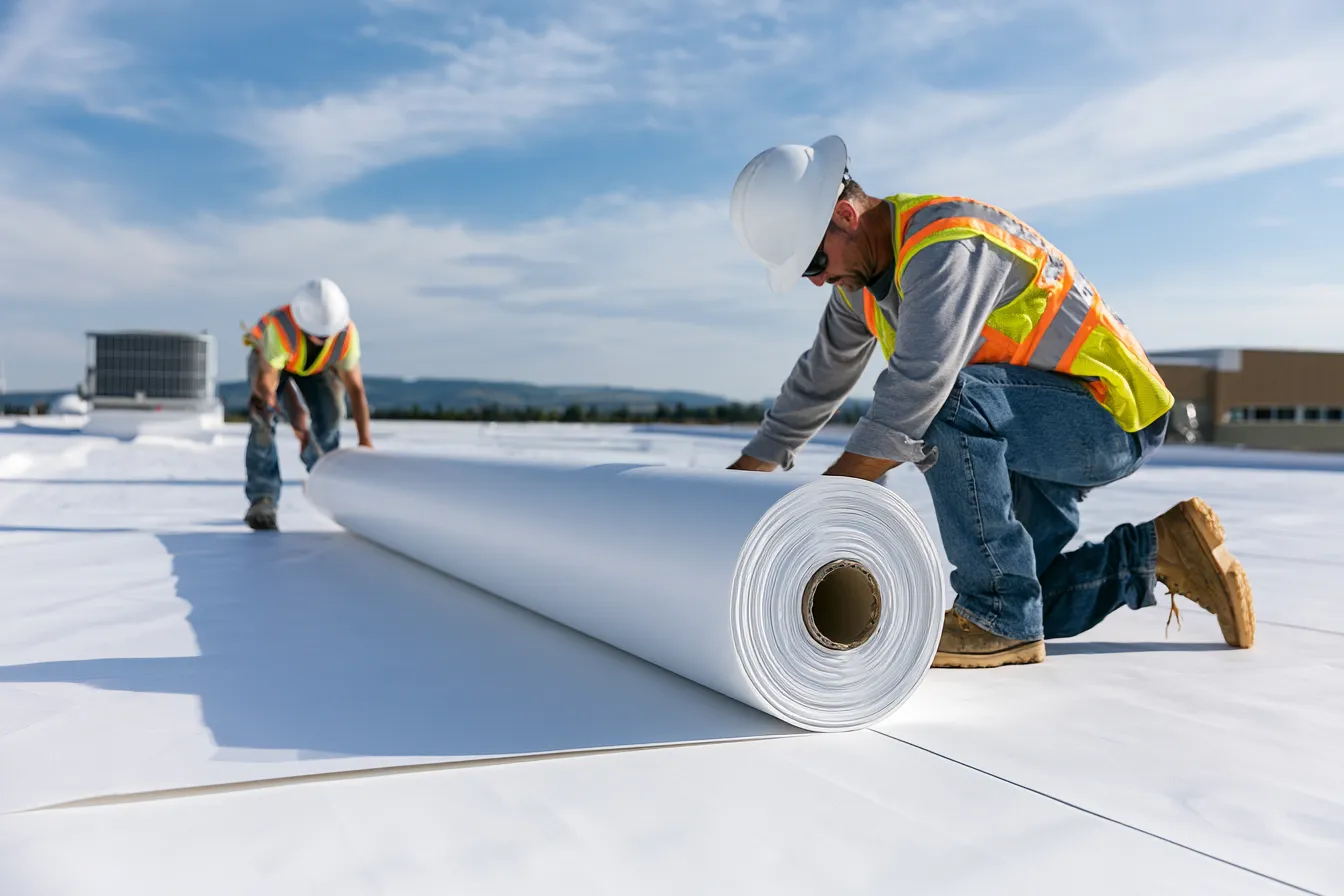
Commercial Roofing in Springdale, AR
A Springdale flat roof works hard against Washington County hail, and the damage hides from the ground. Arkansas expects a commercial contractor license above fifty thousand dollars, a standing check on every crew sent to your building.
- Insurance steps laid out in plain English
- No pressure to commit on the spot
- Workmanship coverage stated in writing
Commercial roofing in Springdale starts on file
A residential roofing job over two thousand dollars runs under a state registration and a fifteen-thousand-dollar surety bond, while a commercial project of fifty thousand or more calls for a full Arkansas contractor license. Most re-roofs on a Springdale building clear that line, so an owner first verifies the license and current insurance with the Contractors Licensing Board.
A food-processing plant, a distribution warehouse, and a strip retail center mostly run flat or low-slope membranes. A local roofer reads the field, the seams, and every rooftop curb, then dates the condition before any number. A no-cost inspection opens the file.

The membranes on Springdale's working roofs
The right membrane is a match to the building, not a favorite. What decides it is how the deck sheds an Arkansas cloudburst, how much foot traffic the rooftop units draw, whether a kitchen or plant vents grease across the field, and how a sheet takes a hailstone in a county that sees real hail. The read and the dated photos come first; the system name comes after.
TPO
A white single-ply welded into one continuous skin, common on Springdale's newer retail and office builds. The bright surface pushes the Arkansas sun back off the roof to ease the summer cooling load, and because a thicker sheet takes a hailstone better, the mil is matched to a county that gets real hail.
EPDM
A synthetic-rubber membrane whose long track record earns it a place on the wide, open decks of a Springdale warehouse or plant. It runs for decades across a big floorplate, and its one weak point is the seams, so seam upkeep and a dated read after a hailstorm are where the attention goes.
PVC
The membrane to reach for when a kitchen or a food plant is on the roof. Welded PVC shrugs off the grease and fry-line exhaust that would rot an ordinary sheet, which is why it earns its price in a working food city like Springdale. Restaurants and any grease-venting tenant are where it pays back.
Modified bitumen
Reinforced asphalt in torch- or self-adhered rolls, thick enough to walk without worry and to forgive a slow-draining corner. A sound pick for a smaller Springdale building whose roof gets regular foot traffic to the rooftop units, with a layered top sheet that stands up to hail better than a thin membrane.
Built-up roof (BUR)
Layer on layer of asphalt and gravel, the heaviest and oldest system here, and the redundancy is the point: multiple plies mean one bruised spot does not open the roof. It still tops a number of Springdale's older commercial buildings, where that long service earns back the heavier install.
Roof coatings
A rolled-on silicone or acrylic membrane laid over a tired but sound roof, a restoration that buys reflective years for well under the price of a tear-off. Two things govern it: a deck that scans dry, since coating over trapped moisture only locks the water in, and a real read of whether a coating is enough for a hail-worked roof.
Not sure what membrane is up there, or how many hail seasons it has quietly taken? A single read answers both. A local roofer names the membrane, puts a realistic number of years on what is left in it, and logs and dates any hail bruising or open seam, all before the repair-or-replace decision is on the table. For the deeper read on each system, see TPO roofing, flat roof and EPDM, and roof coatings; the new roof cost guide breaks the ranges down system by system.
Four scopes, each on paper before a price
Four scopes cover almost every commercial roof, and the documented read, not a hunch, decides which. Whatever it shows goes in writing before a crew is booked.
- 01A targeted repair, held to one failure
- The single fault fixed on its own: a seam lifting, a drain that ponds after a downpour, brittle parapet flashing, or a leak at a rooftop-unit curb, each pinned to whichever membrane is actually up there and photographed where it failed.
- 02A coating where the deck has earned it
- Worth it only when the insulation below scans dry and sound: then a rolled silicone or acrylic coat renews the surface for a fraction of a tear-off. Over trapped moisture a coat only seals the water in, which is why the moisture survey comes first and the recommendation second.
- 03A full re-roof when the membrane is spent
- A fresh low-slope assembly, single-ply, modified bitumen, or built-up, fastened for the wind an Arkansas storm brings and detailed at the seams and edges, chosen only once patching has stopped earning its cost. Every layer and code item lands on the estimate before tear-off.
- 04The coat-or-replace call, weighed four ways
- One decision, four inputs, none skippable: how much rooftop traffic the roof sees, whether moisture sits in the insulation, the condition of the deck under it, and the years you plan to hold the building. They get weighed together, on paper, well before a crew is quoted.
Hail hides better on a flat roof than on a pitched one. From the ground a bruised membrane or a split seam looks like nothing, and Washington County runs a busy hail record. So the first visit includes close, dated photos of any bruising or seam separation, tied to the storm. The storm damage page covers what a flat roof conceals after a hailstorm.
How a documented commercial job runs
The roof goes on record before any number, and the work fits your operating hours.
Verify the Arkansas license, then go up
First, an owner confirms the company holds the Arkansas contractor license a commercial job over fifty thousand dollars requires, plus current insurance. Only then does a local roofer read the membrane, seams, drains, and curbs, and come back with dated photos beside one written figure.
One scope on paper, sized to the building
A repair or a replacement is spelled out plainly and priced to the building's budget cycle, with every layer and code item on the estimate. The figure is locked before a crew is booked, and when the work happens stays your call.
Install to spec, then close it on file
The membrane goes down, or the repair closes to the written spec, then a closing walk of every seam, drain, and flashing is shot and dated before the workmanship terms land in your file. The record is the roof's, from the first read to the last photo.
Questions Springdale owners raise before signing
The practical questions that come up before an owner approves a commercial roof scope.
Q1How do I confirm a Springdale commercial roofer holds the Arkansas commercial license?
Q2How does hail damage show up on a flat commercial roof?
Q3Coat the membrane or replace it, how is that decided?
Q4Which membrane is right for a food plant or a building with rooftop kitchen exhaust?
Q5A tenant reports a drip, but the membrane is fairly new. Why?
Q6On a new commercial roof, who backs it, the maker or the roofer?
Put your Springdale commercial roof on file
Put your building in front of Springdale Apex Roofing, and a commercial roofer reads the membrane, dates every tired seam and slow drain, and prices a repair or a full replacement on one page. Nothing moves until you approve it.